Tuesday, December 10, 2013

More from Thailand

As part of the kayaking trip we also made Kratongs which are made of banana tree trunk slices decorated with banana leaves and orchids.  Kratongs are traditionally floated on a river or in the ocean at the time of the new moon festival.  They also have candles and incense on them.  We made one on and floated in from our kayak.

Making a Kratong with our paddling guide.

Add caption

All the Kratongs waiting to be launched in the ocean

Paddling around one of the islands on our own

This time Dan is actually paddling.

Delicious Thai dinner on the main boat.

One month later….

It has been a busy month!  I have been all the way around the globe and now I'm back in Dhaka.

This post will be about the trip to Thailand.  Which was the first stop on my round the world trip.

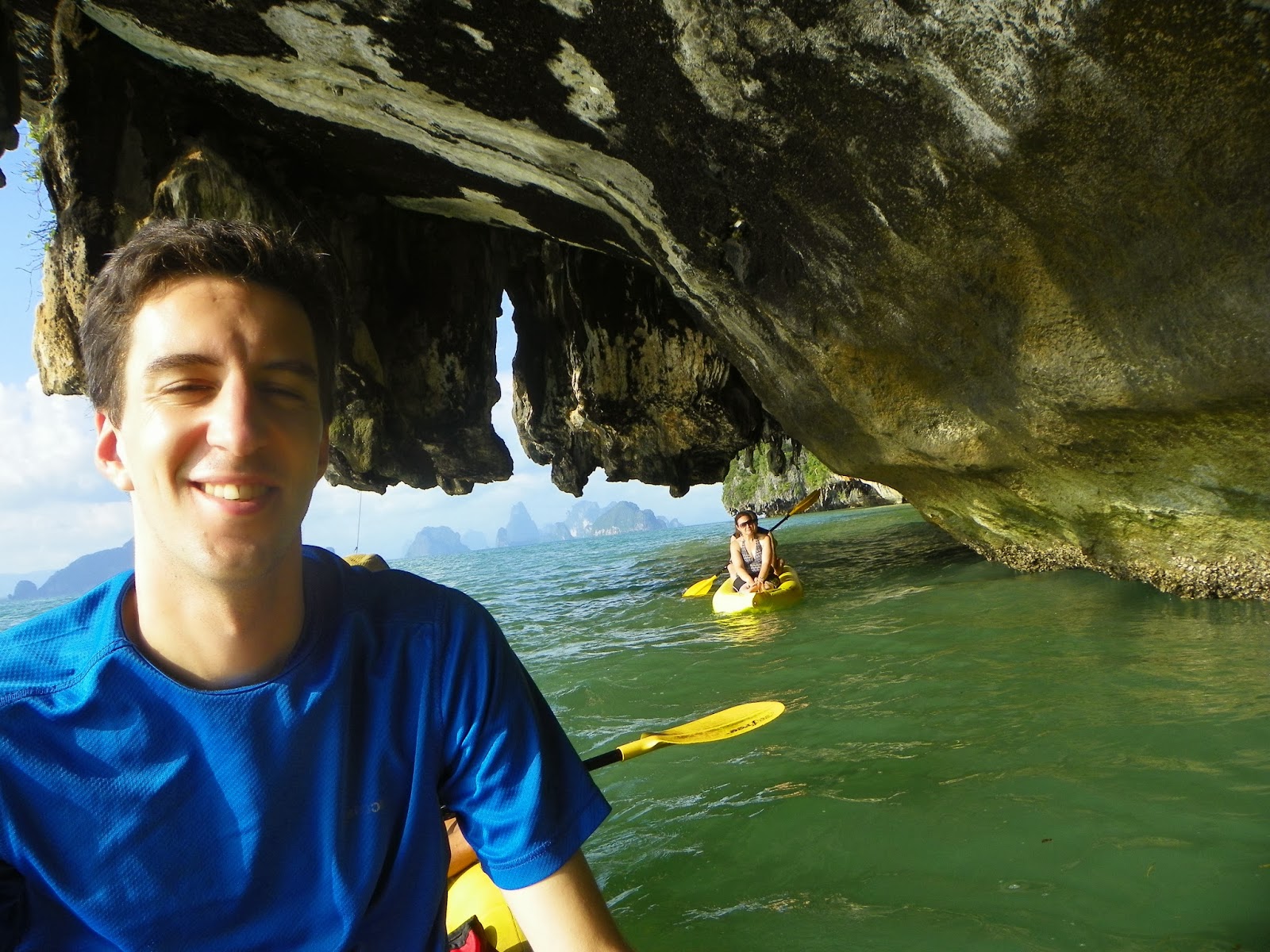
Thailand was great.  It is spectacularly beautiful.  The highlight was visiting the Hongs in Phang Nga Bay. These are islands shaped like donuts, the inside has been hollowed out by rainwater eroding the limestone.  There are shallow sea caves which allow you to enter the inside of the islands by kayak.


Kayaks entering the sea caves 
Inside the cave; it was so short we had to lie down to get through!

Emerging from the cave into the central lagoon of one of the islands.

Mangroves fill the centre of the island.


Actually we didn't get to paddle, only our guide did! 

Paddling along the edge of the island under the limestone formations.


Entering a larger cave.


Exiting a shallow cave.

Paddling through the cave.

Inside the cave.

Monday, November 4, 2013

More detailed post about my work in Bangladesh


This post is intended to explain in more detail the work that I am doing at BSMMU.  All of the work that I am doing is on a volunteer basis.

The Hospital: BSMMU
I am working on a children's cancer ward.  The ward is in a large public hospital in downtown Dhaka called Bagabadu Shiek (BSMMU).  The wards are staffed by a team of attending physicians pediatric oncologists (children's cancer specialists), residents (trainee doctors), and nurses.

The hospital consists of 3 large tower blocks.


Costs
Despite being funded by the government, the hospital covers only some of the costs for patients.  There is no charge for the bed for the child and the physician and nursing care.  The patient and family is responsible for all others costs: medications, medical equipment (IV tubing, needles, etc) and tests (blood tests, x-rays, etc). Given the expense, many families are forced to stop treating their child's cancer as it becomes unaffordable; this is referred to as treatment abandonment.  Unfortunately if treatment is stopped, the child will die from their cancer. The treatment of cancer in children generally lasts for several years.  
The ward, may look clean, but it flooded with water from overflowing toilets last week.  

Diagnostic Issues:
Many pediatricians in Bangladesh are not able to diagnose cancer in children, meaning that despite a child presenting to their clinic with concerning symptoms, they will not recognize that the child has cancer or refer them to someone who could make the diagnosis. This is due to poor quality medical training.  There is a lack of awareness amongst doctors that effective treatment is available for children's cancer. Parents are often told to simply take their child home to die.  

The Twinning Project: Children's Cancer Conference
BSMMU started a twinning project with BC Children's Hospital and University College London several years ago.  The twinning project is facilitated through World Child Cancer which is an NGO that works in developing countries to help children with cancer get treatment.   Together the teams from Vancouver, London and Dhaka host an annual 4 day conference on children's cancer, aiming to teach pediatricians and pediatric oncologists from all over Bangladesh how to recognize and treat cancer in children.  The conference will be held in December, and I will be giving several lectures on pain and palliative care for children with cancer.
Poster for the upcoming seminary in Pediatric Hematology and Oncology, Dec. 8-11, 2013.
The Twinning Project: Chemotherapy Costs
World Child Cancer also funds a portion of the cost of chemotherapy for families who cannot afford these medications.

My Projects: Pain Treatment
One of my specific projects is to teach the doctors and trainee doctors how to assess and treat pain in children. The children on the ward are often in terrible pain, but the doctors do not know how to safely prescribe medications for pain (like morphine) because it is not part of their medical training. Access to morphine is also very tightly controlled, much more than in Canada, so that even if morphine is prescribed it is very difficult for the family to purchase it.  I will also be working to have morphine available on the cancer ward 24 hrs per day and to develop pain treatment guidelines. 

My Projects: Procedural Pain
I am also working to develop a pain treatment plan for when children have spinal taps or bone marrow biopsies done.  These are painful and frightening to children.  Currently the children are not receiving any medications or other interventions to help with these procedures.

Applying freezing cream to the back before a child has a spinal tap to decrease pain.  We are hoping to start doing this in all children.  In Canada, all children would have sedation (light anaesthesia) for spinal tap or bone marrow biopsy procedures.
My Projects: Palliative Care
I will also be teaching the physicians the principles of palliative care.  The survival rate in Canada for children with leukemia is 85-90%.  In Bangladesh when a child is diagnosed with cancer, 30-40% of families will not even start treatment due to cost.  For those that start treatment, the rate of survival is only 40%, due to much higher rates of complications and treatment abandonment.  The physicians need education about principles of how to care for children who are dying, as they have never received any training in this area of medicine.
Doing rounds with Dr. Islam, oncologist, discussing palliative care and pain issues as we do rounds.


My Projects: Art and Play Therapy
Art therapy is frequently used to help children cope with stressful experiences and express their emotions.  I am using this therapy to help children to cope with painful events such as bloodwork and prolonged hospitalizations which often cause children to be very sad.  I working to involve other interested professionals in this work in the future.

Do you want to help?
Contact me and I can give you more details about some of the current needs of the project.
Donations can be made through the World Child Cancer website.  Please specify that the donation is for Bangladesh.

www.worldchildcancer.org

Saturday, October 26, 2013

BSMMU Children's Cancer War

Here are some photographs from my work at BSMM (Bangabandhu Sheikh Mujib Medical University, essentially a large teaching hospital and university).  I am working on the children's cancer (oncology) ward.  Some of the activities of the oncology ward are sponsored by World Child Cancer as part of the partnership between BSMMU and University College London (England) and BC Children's Hospital in Vancouver.  This project sponsors the creation of a database to register all cancer patients at the time of diagnosis as well as covering part of the cost of chemotherapy.  

More details coming soon...

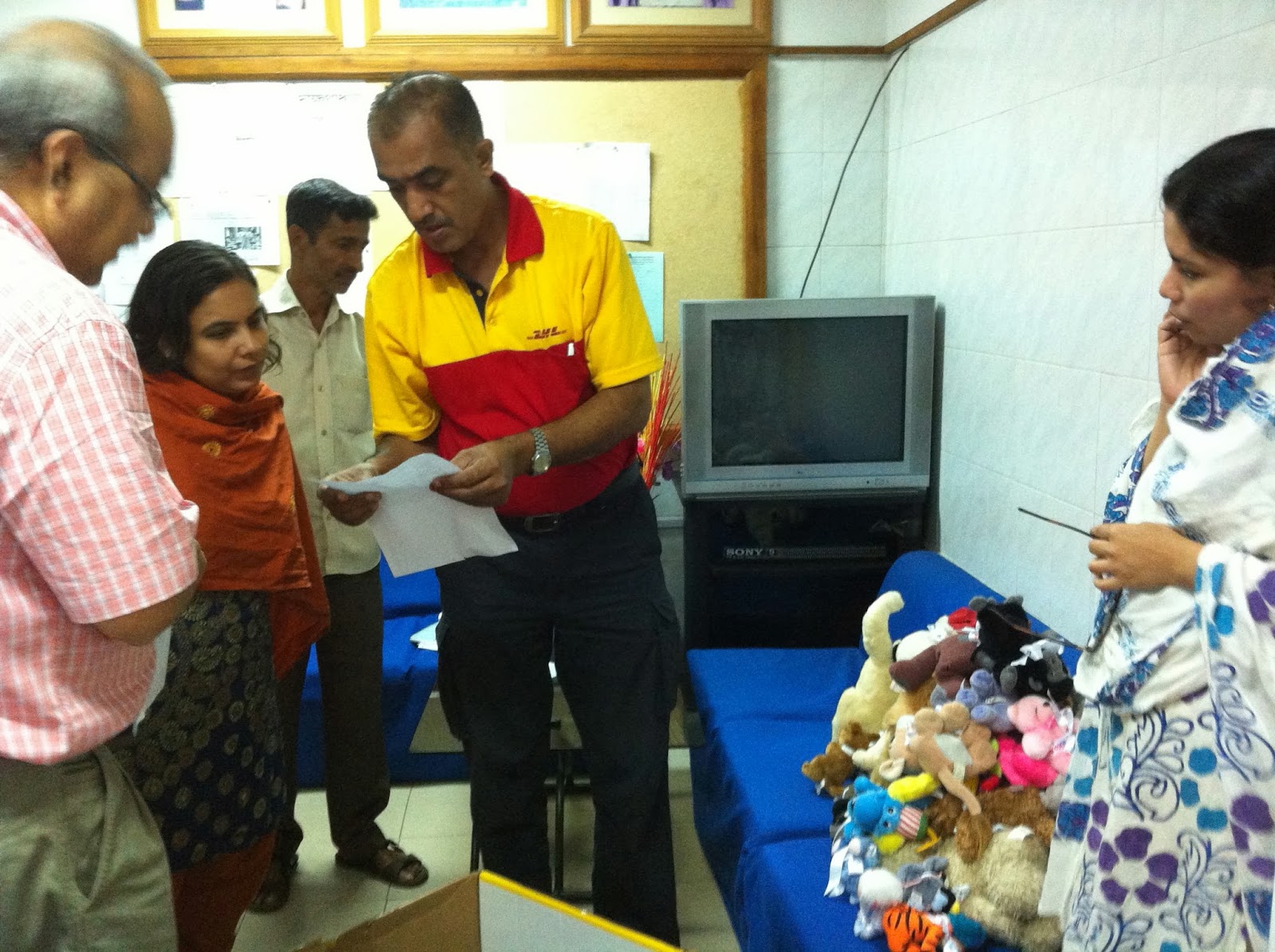
More stuffed toys arrive from World Child Cancer

DHL man assures us that the count of toys is correct....but where is the second box?  (He flatly denied its existence, it then arrived 2 days later)

Doing rounds on the ward with Dr. Islam.  

This little guy woke up just long enough to put his hand on Dr. Islam's, then dozed off again...


You thought hospital food in Canada was bad...this is what the patients get for lunch and dinner, every single day it is the same thing.  It costs the hospital about $1 per day to feed each patient.  Unfortunately this food is spicy and children in Bangladesh do not eat spicy food.  So none of the children will eat this food.  This means the the parents have to prepare some food at the bedside for the child to eat, which is not very hygienic.  One of the goals of the World Child Cancer project is to educate the parents about while foods are healthy and safe for their child with cancer.  

16 bed cancer ward.  There are 4 slightly more private "cabins" in the back.  These cost $2/night.  Otherwise there is essentially no privacy, everything happens in full view of all the other patients.  One parent will stay with each child at night, sleeping in the bed with them.

Parents, brothers and uncles of some patients.  These gentlemen helped me to decorate the walls of the procedure room (behind them). 

A lovely little girl with cancer who was coming for a spinal tap today.   Parents are both with her.

Walls of the procedure room after decoration.  Currently spinal taps and bone marrow biopsies are being done without any form of sedation or pain relief.  I am working to develop a safe and simple plan for pain and sedation medications to be given to the children before these procedures.  The wall decorations are part of our non-pharmicological strategy to help the children be more calm during the procedure, by using distraction we are able to help children cope better with pain.  

Dr. Rasel giving a talk on nutrition to the parent group.  This is a group of parents whose children all have cancer.  They are hoping to form a foundation and start to support and educate parents when their child is newly diagnosed with cancer.  Dr. Rasel is very keen to help this group with their activities.  They were very excited to have me visit their meeting.  The father on the far left even gave a very nice little speech about how happy they were to have me join the meeting (he is a math professor in Chittigong)

The streets of Dhaka

Every day when I travel to BSMMU (the hospital where I work), I spend about an hour and a half in traffic in total.  As I have a driver, this is a great time to observe the life on the street in Dhaka.  Traffic is pretty crazy, but I do occasionally drive myself.  Mostly only on Fridays when traffic is lighter.
Sitting in traffic.  Rickshaws try to out-maneouvre cars here all the time.

Bridge on my way to work.  One of the few roads without any traffic.

A whole truck full of garlic...Antoine this if for you! (although, they have not figured out how to make hummus yet)

Auto rickshaw (called CNG here) waiting in traffic beside my car. 

Generalized chaos at a round-about.

Zipping through the city in the early morning.

Monday, October 21, 2013

Back in Dhaka!

Well the weather hasn't changed in Dhaka in the 2.5 weeks when I was gone.  It's still hot and humid, although perhaps a little less so.

I am back at work here after a few days break to recover from jetlag.  Last week was Eid, which is not a good time to be a goat or a cow or even a camel as many families buy one of these animals and slaughter it as part of the celebration.  The animal is butchered right on the street outside the house!  I am not including any pictures of this but it does lead to some gruesome sights walking down the street.  The meat is then distributed to friends and neighbours as well as the poor. You see many people walking around with bloody plastic bags filled with meat!

As a friend of Dan's put it:  "Mary had a little lamb...not any more!"

More photos coming soon...

Sunday, October 6, 2013

Hiking in Calabogie

Jolene and I 


Ben, you probably shouldn't eat that mushroom....